A founder record about building, rights, and accountability
The corporation is now in place. The company is already being built—and I am still calling for accountability.
Some startups begin as a pitch deck. State of Stick began with a physical object, a strange idea, and the stubborn belief that the thing in your hand could have a longer, more interesting life.
That is the fun of it: we get to make real things, give them a digital afterlife, and ask serious questions without making the work feel like a board meeting. The Physical Identity Manifesto is the clearest starting point; State of Stick Golf is where the idea gets a course, a scorecard, and somewhere to play.
I recently got off the phone with someone I met while studying computer science at Baker College.
The conversation stayed with me because he seemed uncertain that what we are building matters—or that it could attract funding.
I understand the reaction.
State of Stick, Co. sits across physical products, manufacturing, software, digital identity, connected experiences, and artificial intelligence. From the outside, that can sound broad. If the only thing someone sees is an early emblem or a tap-enabled object, it is easy to mistake the object for the whole company.
But a physical product is only the beginning of the system we are building.
The conversation also brought me back to a more personal question: what do you do when you believe a system has treated an important safety concern as inconvenient, and you still have to keep building your life afterward?
My answer has been to document what happened, use the lawful channels available to me, ask for accountability, and continue building systems that make identity, evidence, authority, and responsibility easier to examine.
The more useful question is not whether the company has already raised money.
The more useful question is: what has actually been built, what remains unproven, and what can we do next?
Serious About the Record. Still Here for the Fun.
State of Stick is serious about evidence, permissions, and responsibility. It is not trying to look serious every minute of the day.
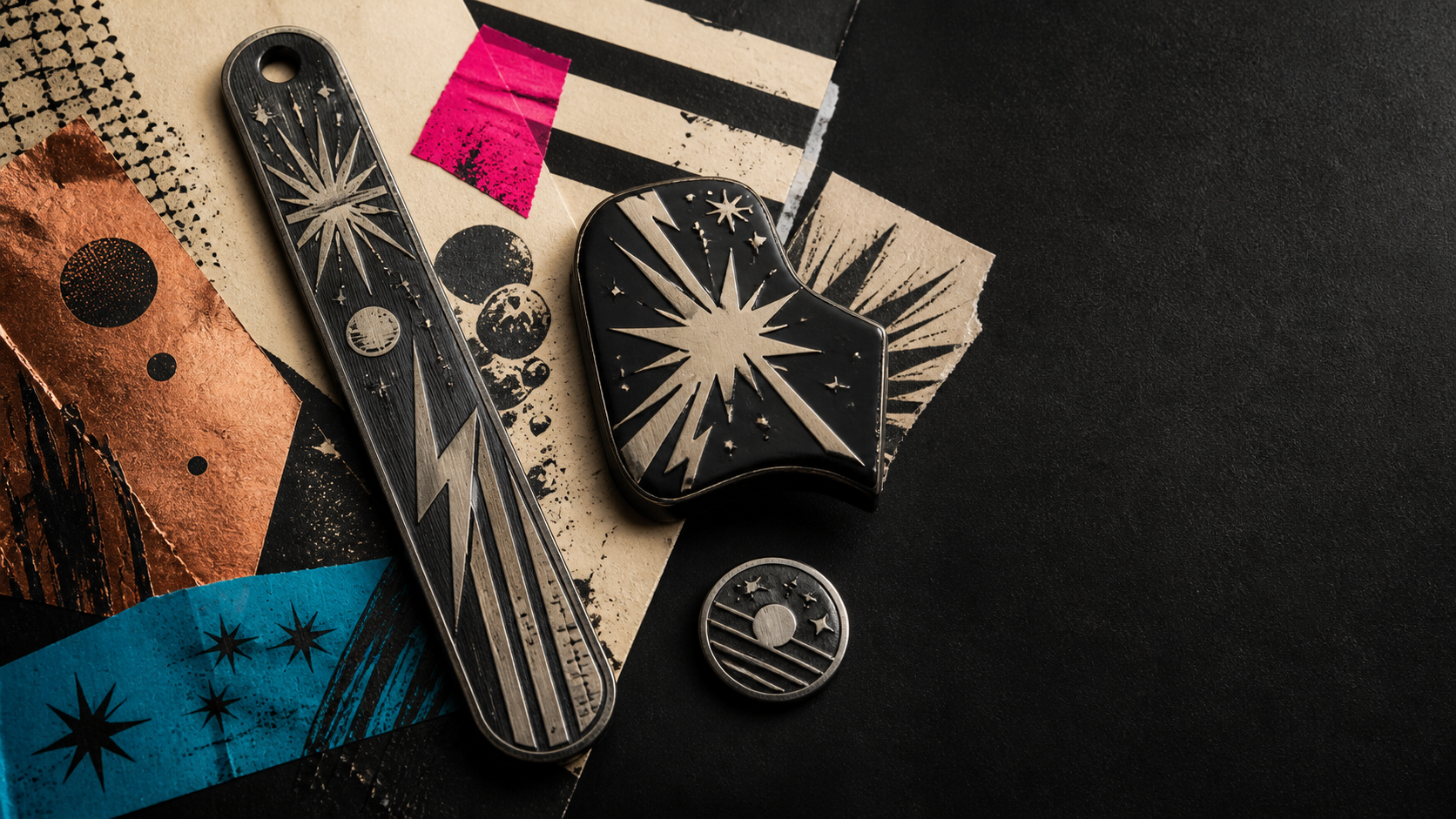
We make collectible objects, playful emblems, bold surfaces, and connected experiences because people remember what they can touch. The copper, the ink, the odd shapes, the little flashes of color, and the occasional weird idea are not decoration around the platform. They are part of how the platform invites someone in.
The same company can care about a verifiable score, a beautiful physical artifact, a clean audit trail, and a good time. That combination is the point. Explore the Connected Product Intelligence work or follow the investor-facing company story for the wider picture.
The Corporation Is Now in Place, and We Are Still Building
We started building State of Stick in March 2026.
State of Stick, Co. Inc. is now a Michigan profit corporation owned and operated by TechFlunky Labs, LLC. A conventional corporate structure can make future investment, equity, governance, grants, partnerships, and hiring easier to organize.
The remaining ownership, capitalization, IP, governance, and financing records are important, but they are not the beginning of the work.
The company has continued developing while the paperwork catches up.
That distinction matters. A corporation can own and organize a business. It does not create the product, the manufacturing workflow, the customer problem, the technical architecture, or the evidence that a market cares.
Those things have to be built and tested. They also have to be governed by records strong enough to distinguish what happened, who is responsible, what is verified, and what remains disputed.
That is not a side concern for State of Stick. It is part of why I am building it.
What State of Stick Is Building
The central idea behind State of Stick is physical identity infrastructure: making physical products, places, and interactions easier to identify, understand, and hold accountable over time.
We are exploring how a physical product can remain connected to an appropriate, governed digital experience after it leaves manufacturing. Depending on the product and use case, that relationship may support:
- authentication and product recognition;
- ownership or registration records;
- provenance and lifecycle context;
- warranty, service, or entitlement information;
- controlled digital experiences;
- commerce or partner journeys;
- interaction records; and
- specialized software or AI experiences.
The object is not merely a carrier for a link. It can become a durable entry point into a system that has identity, permissions, context, and responsibility behind it. A trustworthy system should not ask people to rely on a slogan when it can provide a record.
That is the larger platform thesis. Our Connected Product Intelligence work explores the software side of that relationship. It is also why the work cannot be accurately described as only making stickers, emblems, or NFC tags.
The physical product matters. The system around it matters too.
Golf Is the Clearest Working Example So Far
State of Stick Golf has become one of the clearest ways to make the platform concrete.
The golf application is a standalone Astro and Cloudflare Worker/D1 project. It has a golf-specific domain model for courses, holes, tee sets, rounds, score records, leagues, standings, player passports, physical touchpoints, operator services, and course knowledge.
The current public experience includes demonstration pages, but the repository also contains a real backend foundation. That foundation includes authenticated round persistence, score recovery, round submission, operator review, audit history, course publication controls, tee-time activation, service requests, league matches, and platform-event forwarding. The public Golf system shows the vertical’s intended product surface, with its live status and course relationships still subject to the evidence boundaries described here.
The scorecard is designed around an important accountability boundary: different kinds of information should not be presented as if they have the same authority.
One round can contain several related records:
- official strokes under the selected rules;
- format points such as Stableford;
- physical evidence such as a tap or witness confirmation;
- operator or course review;
- and the golfer’s passport history.
Those records can work together without becoming the same thing. That separation is how a system avoids turning an assertion into a fact merely because it is convenient.
A tap is not automatically proof of a score. A witness confirmation is not automatically an official result. A player-entered handicap is not automatically a governing-body handicap. The system is being designed to preserve those distinctions.
What a Golf Round Can Become
The proposed golfer journey is straightforward:
tap → identify → play → score → verify → interact → return
A golfer could use a course touchpoint to open the right hole or course context, record a score, receive approved local guidance, confirm participation, join a league, request a service, or carry the round into a passport.
For an operator, the same network can provide controlled tools for course facts, map layers, tap points, announcements, service requests, round review, tee-time operations, and activity metrics.
The system also supports portable competition: a league can allow golfers to play eligible rounds at different participating courses while preserving the course, tee set, score, trust level, and ruleset attached to each round.
That does not mean we have a national golf network operating today. It means the product foundation is being built to support that kind of workflow.
The displayed Cedar Ridge course, league counts, operator activity, and golfer history are demonstration records unless separately identified as live. The repository is intentionally explicit about that boundary.
The Intelligence Layer Is Narrow on Purpose
The golf build includes an intelligence layer, but it is not AI theater and it is not an autonomous golf official.
The first provider is a deterministic rules engine. It can summarize recorded rounds, describe limited scoring trends, identify a possible practice focus, explain published league data, and provide operator summaries. Results include source facts, confidence, timestamps, rule versions, provider identifiers, and advisory status.
There is also a bounded Golf Agent path using Cloudflare Workers AI. It receives approved course context and is instructed not to invent a hole, yardage, local rule, condition, service, price, player fact, league result, or completed action.
The intelligence layer can explain authorized records. It cannot create official scores, decide a winner, calculate an authoritative handicap, change a standing, place a real order, or publish course information without human and system controls.
That approach is important to the larger State of Stick platform. Identity and context should come before automation. AI should operate inside a governed record, not replace the record. The goal is not to automate accountability away; it is to make responsible review more possible.
The Platform Is Connected to the Rest of State of Stick
Golf is a vertical application, not a second identity platform.
The golf repository is designed to use State of Stick as the authority for shared identity, people, organizations, entitlements, physical StickLinks, commerce boundaries, and platform analytics.
The current integration foundation includes:
- signed State of Stick identity assertions;
- organization and person identity references;
- entitlement and session checks;
- a retry-safe golf event outbox;
- forwarding into the State of Stick platform event queue;
- Cloudflare D1 for authoritative golf records;
- Durable Objects for live overlays and coordination; and
- Stripe checkout and webhook foundations for future operator subscriptions.
These are implementation seams and foundations. They are not claims that every external integration is live, that a course has adopted the system, or that revenue has been generated through it. The boundary matters because accountability begins with saying exactly what the system can prove and what it cannot.
There is no claim here of an active GHIN connection, governing-body handicap feed, POS integration, live satellite provider, or installed network of course hardware. Those are separate validation and implementation steps.
The Three Paths Forward
The phone conversation also clarified something for me: funding is one path, not the only path. None of the paths forward requires me to abandon the call for accountability that shaped this work.
Bootstrap
We can continue building from the code, materials, manufacturing capability, prototypes, and infrastructure already available. Bootstrapping may be slower, but it keeps the work moving and forces us to prioritize useful products, real customer problems, and records that can withstand scrutiny.
Demonstrate and sell
Public demonstrations can turn the physical system into a product showcase, content opportunity, and potential sponsorship environment. They help people understand the technology by letting them interact with physical objects rather than asking them to understand an architecture diagram.
The installation is an opportunity, not guaranteed funding or proof of adoption.
We can also continue pursuing customer implementations, paid pilots, physical-product programs, and partner-led applications where the use case is concrete enough to test.
Pursue outside capital
We can pursue grants, investors, strategic partners, manufacturing relationships, and pilot programs. Capital could accelerate engineering, production capacity, sales, implementation, infrastructure, and vertical development. It should also strengthen the company’s ability to document decisions, protect people, and make its claims accountable.
But there is a difference between needing capital to make an idea exist and using capital to accelerate a system that is already being built.
We are working toward the second category while remaining honest about what is still unproven.
What the Friend’s Doubt Helped Clarify
I do not need every person to immediately understand the opportunity.
But I do need to explain it more clearly—and I need to explain why accountability is not separate from the opportunity.
The answer cannot simply be that State of Stick has many possible applications. Breadth without a working entry point sounds like indecision.
The better answer is that we are building a shared physical-identity foundation and choosing concrete verticals where the value can be tested. Golf is one of those verticals because the physical environment, recurring participation, scoring context, operator needs, and collectible culture make the relationship visible.
The right standard is not whether someone is impressed by the idea on a phone call.
The right standard is whether a golfer, operator, manufacturer, retailer, artist, sponsor, or customer can use the system to solve a defined problem—and whether the evidence supports the next step.
That is how a broad platform becomes a real company.
Stoicism Does Not Mean Silence
There is another part of this story that matters to me personally.
I describe myself as Stoic—not because I believe people should accept every decision made by a powerful person or institution, and not because I think endurance means staying quiet. For me, Stoicism means trying to control my conduct, tell the truth as carefully as I can, keep records, act with courage, and continue doing the work even when I cannot control the outcome.
That outlook was shaped in part by my experience as a trucking safety whistleblower. I filed an OSHA whistleblower complaint under the Surface Transportation Assistance Act framework after raising a concern involving a federally required rest break and commercial-driver hours-of-service rules. I also wrote to the Federal Motor Carrier Safety Administration, within the U.S. Department of Transportation, seeking clarification about whether a conversation with my supervisor counted as on-duty time. FMCSA responded in writing to that question. In ordinary language, someone might call this a DOT or FMCSA whistleblower story; the more precise description is an OSHA/STAA trucking-safety complaint accompanied by an FMCSA/DOT hours-of-service inquiry. The experience taught me that having a right and being able to exercise it easily are not the same thing.
The Constitution matters here. The First Amendment protects the right of people to peaceably assemble and to petition the Government for a redress of grievances. That is one reason I believe asking for accountability through lawful channels is not an unreasonable act or a sign of disloyalty. It is part of civic life. The official text of the First Amendment describes that protection directly.
I am not claiming that every private disagreement is automatically a constitutional violation, or that this blog can decide the legal merits of a particular whistleblower matter. Constitutional protections, whistleblower statutes, employment rules, and available remedies depend on the facts, the actors involved, the forum, the evidence, and qualified legal review.
The principle is simpler: accountability should not be treated as an attack merely because it is inconvenient. A person can be calm and still object. A person can be disciplined and still ask questions. A person can accept that an outcome is outside their control while continuing to insist that the record be examined.
That is the kind of company I want to build too.
State of Stick is concerned with identity, evidence, context, authority, and accountable records because those concerns are not abstract to me. I have experienced what it feels like when the official story, the personal experience, the available records, and the unanswered questions do not line up neatly.
Stoicism gives me a way to keep moving without pretending that the disagreement does not matter. Accountability gives the disagreement somewhere responsible to go.
The Record Is More Specific Than a Slogan
I want to be precise about the whistleblower part of this story because credibility depends on precision.
On November 16, 2012, while working as a commercial truck driver for Midwest Transport, I raised a concern that the schedule for my next run would not allow the federally required ten-hour break after my prior driving shift. I believed accepting the assignment as scheduled could put me in violation of commercial-driver hours-of-service rules. My employer disputed my account of the timing and the reason for my termination.
I did not leave the matter at an argument between an employee and a manager. I filed a whistleblower complaint through OSHA’s process under the Surface Transportation Assistance Act framework. OSHA took a signed statement from me as part of the investigation. I also wrote to FMCSA, the Federal Motor Carrier Safety Administration within the U.S. Department of Transportation, asking a narrower regulatory question: whether time spent speaking with my supervisor about the job counted as on-duty time.
FMCSA responded in writing. Its response explained that on-duty time generally includes time when a driver is working or required to be ready to work, and that a work-related conversation with a supervisor would normally be treated as on-duty time under 49 CFR 395.2.
That letter does not, by itself, decide whether my former employer retaliated unlawfully. It does not substitute for an OSHA finding, a final order, or a court judgment. I am not presenting it as one.
What it does establish is narrower and important: I raised a documented commercial-driver safety concern; I pursued the applicable whistleblower process; I asked the federal motor-carrier regulator for a written interpretation; and the agency answered the specific hours-of-service question I asked.
That is why the most accurate description is an OSHA/STAA trucking-safety whistleblower complaint accompanied by an FMCSA/DOT hours-of-service inquiry. “DOT whistleblower” is understandable shorthand, but it can sound like a formal agency designation or a final finding. I would rather use the longer description and let the record carry the weight.
The fuller account of the employment dispute, the records, the competing interpretations, and the limits of what I am claiming is available in my documented founder record about the trucking whistleblower experience.
The Corporation Will Catch Up to the Company
The Michigan corporation matters. It creates a cleaner structure for ownership, equity, governance, contracts, investment, and future growth, subject to completing the related legal work. I have written separately about the company behind State of Stick; this post focuses on what continues to be built around that structure.
But formation is not the beginning of State of Stick.
The beginning was the physical object, the manufacturing experiment, the first connected interaction, the codebase, the customer problem, and the decision to keep building before every external condition was resolved.
Right now, State of Stick has several valid next steps:
- bootstrap it;
- sell it;
- demonstrate it;
- sponsor it;
- partner around it;
- validate it; and
- keep building it.
That is the honest state of the company.
The corporation is catching up to the company. The work itself is already underway.
And the work is about more than funding, products, or software. It is about refusing to let important claims disappear into confusion. It is about building a company that can say what it knows, show how it knows it, identify who has authority, preserve the record, correct mistakes, and give people a responsible path to question what affects them.
That is what I mean when I say I am calling for accountability. It is not a demand that every outcome go my way. It is a demand that the facts, the process, the rights, and the people involved not be treated as disposable.
If you are working on physical products, manufacturing, golf, retail, hospitality, collectibles, events, or another setting where an object needs a persistent digital relationship, we would like to hear about the problem you are trying to solve.