Founder note
State of Stick began inside a Michigan LLC. Now the platform is becoming real enough that the company around it needs its own foundation.
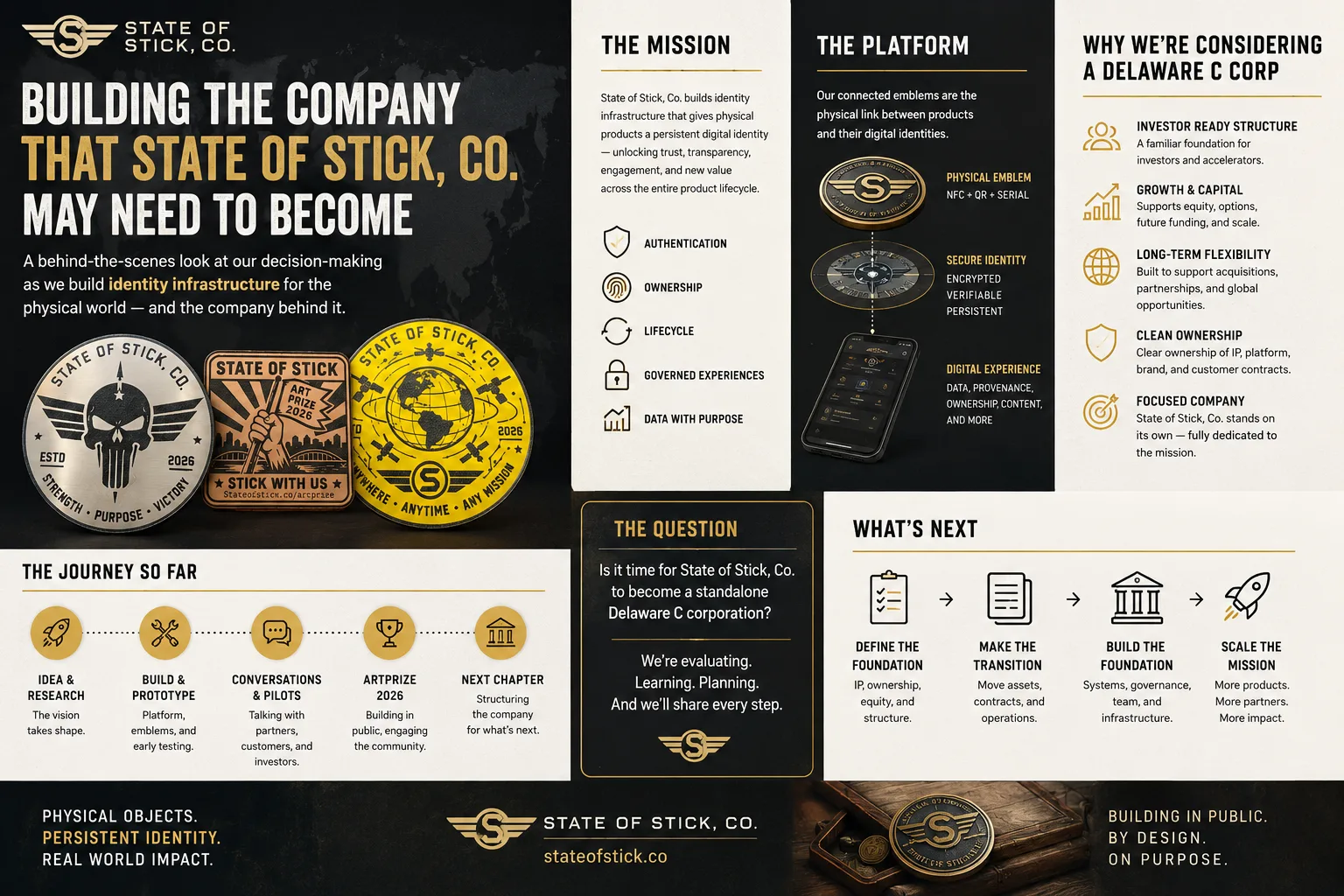
When I started building State of Stick in March 2026, I was not sitting around drawing up corporate paperwork.
I was building.
State of Stick began inside TechFlunky Labs, LLC, the Michigan company that gave me a place to experiment, write code, manufacture physical products, test NFC technology, explore connected experiences, and figure out whether the idea in my head could work in the real world.
It could.
Somewhere along the way, State of Stick stopped feeling like a project inside another company. It became the company.
So we recently took another step forward: State of Stick, Co. Inc. was formed as a Michigan profit corporation owned and operated by TechFlunky Labs, LLC.
That may sound like paperwork. For us, it represents something much bigger.
Now I have to decide what kind of company this platform needs in order to grow.
That is a different question.
What started with connected physical products has developed into a much larger platform vision. State of Stick, Co. is building identity infrastructure for physical products: a system designed to help objects maintain a persistent digital identity after they leave the manufacturer.
That identity can support authentication, provenance, ownership, warranty, service, governed customer experiences, permissioned interaction data, and lifecycle management.
The physical product may be a bottle, emblem, collectible, component, or piece of equipment. The underlying question is the same: can the object remain useful, understandable, serviceable, and connected over time? Our Connected Product Intelligence platform and public platform documentation explain how we think about that bridge between physical objects and persistent digital identity.
As the platform becomes more real, the structure around it has to become more intentional.
We Did Not Start With the Corporation. We Started With the Problem
Physical products lose too much of their identity once they enter the world.
A manufacturer knows what a product is. A brand knows where it came from. A technician may need to know how it should be serviced. A customer may want to know whether it is authentic. A collector may care about provenance. A restaurant may want to tell the story behind what is in a bottle.
But that context often lives somewhere else: in a database, on packaging that gets thrown away, inside a manual, behind a portal, or in somebody’s head.
State of Stick is trying to make that relationship more durable. Depending on the use case, a connected physical object can open into an approved story, product record, authentication flow, warranty experience, service history, collector experience, reorder path, or digital product passport.
The technology is an ingredient. The goal is useful continuity.
Where We Are Today
State of Stick, Co. Inc. is operated through and owned by TechFlunky Labs, LLC, a Michigan limited liability company.
That structure gave me a practical way to begin.
Through TechFlunky Labs, I have been able to build the platform, develop the brand, create physical prototypes, conduct research, explore intellectual-property strategy, test connected-product workflows, and begin conversations with prospective customers, partners, accelerators, and investors.
TechFlunky Labs may also support other technology projects, services, experiments, and intellectual property, so the relationship between the owner and the corporation must remain documented and clear.
An investor, customer, employee, or strategic partner should not have to wonder which company owns the platform, the code, the brand, the customer contracts, or the intellectual property.
The answer should be clear.
The Structure We Formed
State of Stick, Co. Inc. is the Michigan corporation formed to operate the State of Stick business. State of Stick, Co. is the public-facing brand at stateofstick.co, and TechFlunky Labs, LLC owns the business.
Under this structure:
- State of Stick, Co. Inc. is the issuer/entity for the State of Stick business.
- TechFlunky Labs, LLC owns the business and provides the operating foundation.
- The platform, intellectual property, brand assets, domains, customer relationships, and future contracts must be documented between the entities through executed corporate records.
- The business remains operationally based in Michigan.
That last point is important.
The legal corporation, the operating company, the founder’s location, and future facilities are related but distinct records. Here, the operating business remains in Michigan.
This Is More Than Filing Paperwork
The decision is not simply whether to complete a Delaware filing.
The larger question is whether State of Stick, Co. is ready to become a standalone company with its own ownership structure, capitalization, governance, financial records, contracts, and long-term responsibilities.
A new corporation would need to be more than a name on paper.
It would need a clean foundation.
That means deciding:
- Who owns founder shares
- What intellectual property moves into the corporation
- Which source-code repositories belong to the company
- Which domains and brand assets are assigned
- How future employees may receive equity
- How investors may participate
- What remains with TechFlunky Labs
- How contracts and customer relationships transition
- How financial records are separated
- How the company remains compliant in every state where it operates
Those decisions matter far more than how quickly the filing itself can be completed.
What the Structure Needs to Support
State of Stick is being built with the possibility of:
- Outside investment
- Founder and employee equity
- Stock options
- Strategic corporate investors
- A formal board
- Venture financing
- Acquisitions
- International operations
- Potential access to public markets much later
Those outcomes are not immediate, and none of them are guaranteed.
Still, the company structure chosen now can either support those possibilities or create expensive cleanup later.
The Operating Work Continues
The corporation is only one part of the operating foundation. The harder work begins afterward: keeping banking and books aligned, documenting equity, handling payroll, meeting state obligations, and creating records that can survive diligence.
At the same time, “free incorporation” does not mean the company becomes free to operate.
A corporation may still have:
- Delaware annual obligations
- Registered-agent requirements
- Michigan registration and reporting obligations
- Federal and state tax filings
- Accounting costs
- Legal costs
- Insurance requirements
- Payroll and employment compliance
- Ongoing corporate governance responsibilities
The formation cost is only one piece of the decision.
There is something appropriately meta about it. State of Stick exists partly because disconnected systems drive me crazy: the physical product is over here, the information about it is over there, and the useful context is scattered across systems. Every is trying to reduce a similar kind of fragmentation around a startup’s back office. One platform is for the identity and lifecycle of physical things; the other is a possible foundation for the company building that platform.
The Company Investors Would Own
If State of Stick, Co. becomes its own corporation, the structure should be easy to understand.
Investors should invest in the company that owns the business they believe in.
That corporation should own the assets that create its value, including:
- The State of Stick, Co. platform
- Source code and technical documentation
- Product identity and lifecycle systems
- Authentication and authorization logic
- Customer portals and internal tools
- State of Stick, Co. brand assets
- Domains and web properties
- Connected-product marks and emblems
- Manufacturing and provisioning workflows
- Invention disclosures
- Patentable concepts
- Trademark rights
- Customer contracts
- Partner agreements
- Data rights, subject to privacy law and customer contracts
If the corporation does not clearly own its core technology and brand, the structure will not solve the problem it was created to solve.
The foundation question
Investors should be able to understand exactly what company owns the platform they believe in.
The structure is not about sounding bigger. It is about making ownership, responsibility, capitalization, and future contracts easier to understand before the stakes get higher.
Protecting Founder Control
Becoming investment-ready does not mean giving away the company.
It also does not mean accepting money from anyone willing to provide it.
Any financing strategy must balance several goals:
- Preserving founder ownership
- Protecting the mission
- Creating room for key employees
- Making space for strategic investors
- Avoiding unnecessary dilution
- Building a board that strengthens the company
- Maintaining enough flexibility for future rounds
The purpose of forming the right structure is not to surrender control.
It is to make ownership, governance, and investment deliberate.
What Outside Capital Would Be Used For
State of Stick, Co. does not need capital simply to look more established.
Capital would need to produce measurable progress.
Potential uses include:
- Completing enterprise security and reliability work
- Supporting controlled paid pilots
- Hiring key engineering talent
- Building sales and partnership capacity
- Expanding customer success and implementation support
- Improving manufacturing and quality-control systems
- Protecting intellectual property
- Developing enterprise integrations
- Supporting compliance and international readiness
- Creating working capital for larger customer programs
The goal would not be to hire rapidly without proof.
The goal would be to reach the next set of commercial and technical milestones faster and more responsibly.
Michigan Is Still Part of the Story
State of Stick, Co. was built in Michigan.
Michigan has deep connections to manufacturing, mobility, food production, design, materials, craftsmanship, engineering, and physical product innovation.
That matters to our story.
I am not assuming that incorporating in Delaware means leaving Michigan. I am also not assuming that Michigan must remain the company’s permanent headquarters regardless of future opportunities.
The legal home of the corporation, the operating headquarters, the founder’s location, and the location of future facilities can all be different.
Over time, the company may evaluate locations based on:
- Access to investment
- Corporate pilot partners
- University relationships
- Software and cybersecurity talent
- Manufacturing talent
- Commercialization grants
- Workforce programs
- Facility costs
- Transportation and logistics
- State and local incentives
- Founder relocation support
- International business resources
Another state may eventually offer meaningful assistance for State of Stick, Co. to establish a headquarters, production facility, research operation, or technology team.
Michigan may also decide that this is a company worth helping remain and grow here.
That decision should be based on actual opportunity, not assumptions.
Why I May Act Before an Investor Commits
I have asked a few people whether they might be interested in investing as State of Stick becomes a properly documented Michigan corporation.
I have not yet received a commitment.
That does not necessarily mean there is no interest.
Investment decisions take time. People may also want to see whether a founder is prepared to build the legal and financial structure required to accept investment responsibly.
This creates a common founder problem:
Should I wait for an investor before forming the corporation, or form the corporation so investors can take the opportunity seriously?
I am leaning toward building the structure first.
Not because incorporation creates value by itself.
It does not.
The platform, customers, intellectual property, execution, team, and business model create value.
But if State of Stick, Co. is becoming a real standalone company, then its legal and financial structure should begin reflecting what we are building.
The Larger Vision
The long-term opportunity is not limited to connected stickers, labels, or NFC products.
State of Stick, Co. is building infrastructure that allows physical products to maintain identity, trust, and continuity over time.
A physical object can begin with a persistent identity and continue through:
- Manufacturing
- Distribution
- Retail
- Authentication
- Customer education
- Ownership
- Warranty
- Service
- Repair
- Resale
- Reuse
- Recycling
- Archival or cultural preservation
The same underlying platform may eventually support:
- Premium food and beverage
- Specialty retail
- Collectibles
- Sports
- Art and cultural objects
- Luxury goods
- Manufacturing
- Equipment service and warranty
- Product authentication
- Provenance and ownership
- Defense and aerospace
- Medical and regulated products
- Circular commerce
We are not trying to launch into every market at once.
The commercial strategy must remain focused.
But the company structure should be capable of supporting the broader platform if our initial use cases prove successful.
Building Toward a Public-Company Standard
Taking a company public is not an immediate objective.
It is also not something created by adding “Inc.” to the name.
A company capable of eventually reaching public markets must build years of disciplined operations, governance, reporting, compliance, financial controls, and commercial performance.
Still, the habits required later can begin now.
That means maintaining:
- Clear ownership
- Accurate financial records
- Documented board decisions
- Clean contracts
- Reliable capitalization records
- Proper intellectual-property assignments
- Consistent reporting
- Responsible security and privacy practices
- Separation between personal, LLC, and corporate assets
- Evidence supporting public claims
The goal is not to operate like a public company before we have revenue.
The goal is to avoid building in ways that would prevent the company from maturing into one.
What Happens Next
Before making the final decision, I am organizing:
- The State of Stick, Co. intellectual-property inventory
- Source-code and repository ownership
- Brand and domain ownership
- Founder equity
- Initial capitalization
- Potential employee equity
- Existing agreements and obligations
- The relationship between TechFlunky Labs and the future corporation
- Investor and accelerator readiness
- Michigan operating requirements
- Long-term headquarters criteria
- The practical cost of running both entities
The corporation now exists. The remaining work is to complete the ownership, capitalization, governance, IP, contract, and financing records that make the structure ready for investors.
It will be because State of Stick, Co. is ready for a structure designed to protect what we have built and make room for the capital, people, customers, partnerships, and opportunities that could help it grow.
State of Stick, Co. began with physical objects and a bigger idea about identity, trust, and connection.
Now I am building the company around that idea.
What comes next
Define the foundation before scaling the mission.
The next chapter is not only product work. It is ownership, governance, records, contracts, and a company structure strong enough to support the platform we are building.
Founder note: This article documents an active business-planning process. It is not an offer to sell securities or a solicitation of investment. State of Stick, Co. has not announced a formal financing round or established a valuation at the time of publication.
Resources for Founders and Builders
- Explore State of Stick, Co.
- Read the Physical Identity White Paper
- Understand our Trust & Privacy approach
- Explore Connected Product Intelligence
- Read Every’s incorporation overview
- Read Every’s partner-program details
- Review Delaware’s entity statistics
This founder note is for informational purposes and is not legal, tax, accounting, investment, or financial advice. Company formation, tax treatment, securities, equity, and state-registration decisions should be reviewed with qualified professionals.