Founder note
The repair took about five minutes. The cleaning took much longer. The lesson was bigger than either one.
I have never really been afraid to take something apart.
Long before State of Stick, Co., I was already the kind of person who wanted to understand how things worked. I became a ham radio operator. I built drones. I built antennas. I learned electronics, software, fabrication, and the strange patience required when a physical system refuses to behave like the clean diagram in your head.
That background matters here, because this story is not really about a broken wheel.
It is about the founder mindset that says: pause, inspect, diagnose, repair, and keep going.
This week, one of our production machines started making bad work.
The finished pieces were telling me something before the machine fully failed. Cuts that should have been clean were not behaving the way they should. The motion felt off in the result, even before the problem was obvious as a part on the machine.
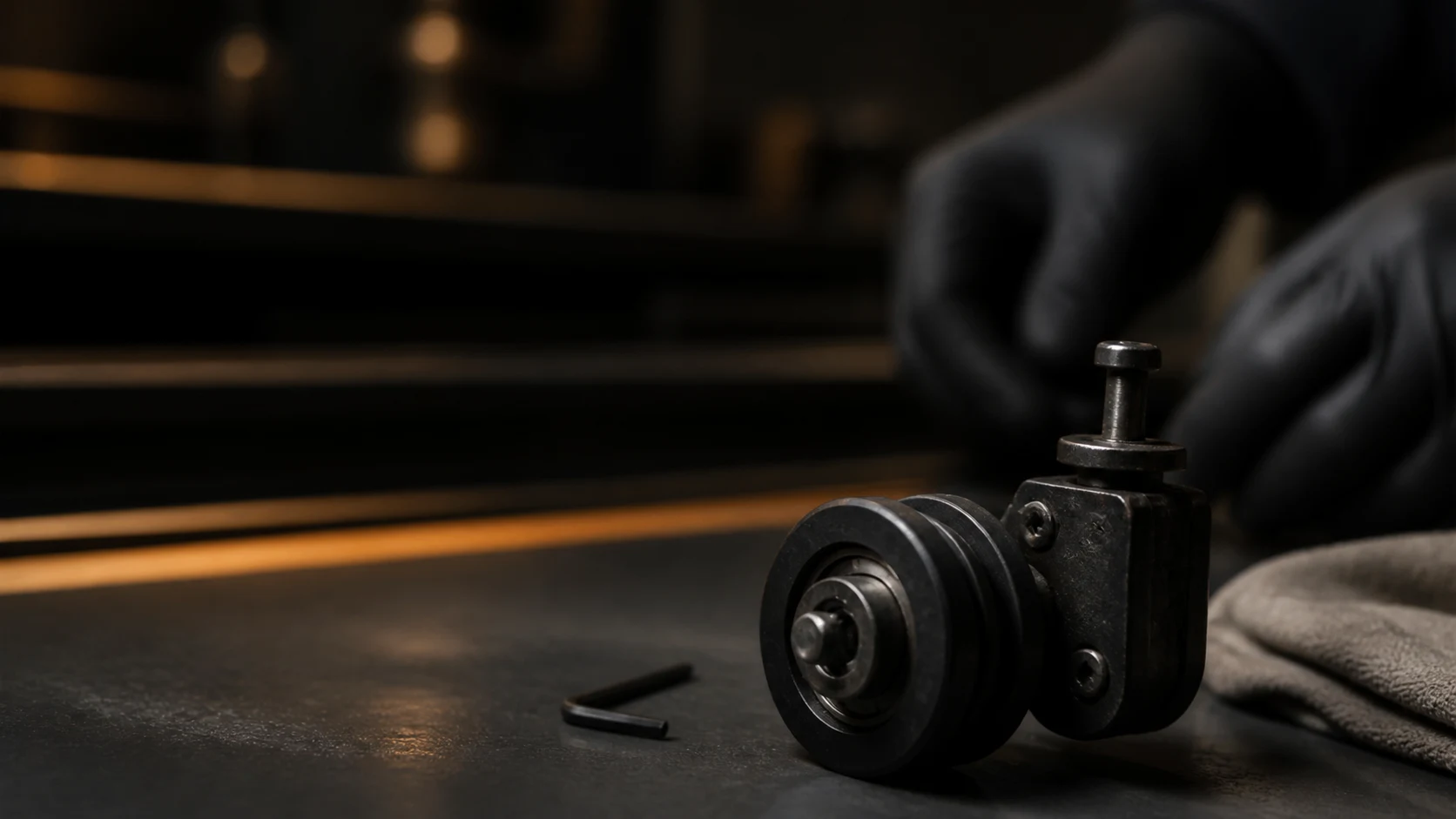
After checking it over, I found the issue: one of the carriage guide wheels on the top rail had worn badly enough to affect the work.
The replacement itself took about five minutes.
I did not have to remove the carriage. I did not have to tear the whole machine apart. The part came out, the new one went in, and the movement was back where it needed to be.
The full cleaning took much longer than the repair.
And honestly, that is the part worth writing about.
Machines Do Not Only Break All at Once
People tend to imagine machine failure as a dramatic moment.
Something snaps. A system stops. A big repair bill appears.
In real fabrication work, failure is usually quieter than that.
A wheel wears unevenly. Dust collects where it should not. A bearing starts adding friction. Airflow changes. A belt or rail stops moving as smoothly as it did last month. The machine still runs, but the output starts carrying the evidence.
If you make physical products, the finished object becomes part of the diagnostic system.
It tells you when precision has changed. It tells you when the machine is no longer repeating the same motion with the same confidence. It tells you when “good enough for now” is starting to become expensive.
Clean Is a Quality Control System
I am intentionally not naming the exact machine or the cleaning process we used.
Some methods stay internal for now. Some details are not useful to share publicly. And sometimes protecting the process is part of protecting the company.
But the larger lesson is safe to say:
Clean equipment is not cosmetic.
It is part of precision.
Dust and residue do not just make a machine look neglected. They can affect motion, heat, airflow, optics, friction, inspection, and the useful life of small parts. They can hide wear until a small problem becomes a bigger one.
When the machine is clean, you can see what is happening.
You can spot the wheel that is wearing strangely. You can tell the difference between a bad setting, a dirty path, a tired part, and a material problem. You can make a decision instead of guessing.
That is why the cleaning took longer than the repair, and why it was still worth doing.
Being Technical Has Always Been Part of This
I know there is a version of this story that could be framed only as a female founder fixing her own equipment.
That part matters. Representation matters. It matters that women build companies, run tools, repair machines, write code, understand systems, and make physical things.
But I do not want the surprise to be that I fixed it.
I am technical. I have been technical for a long time.
Ham radio taught me to think about signal, power, grounding, interference, propagation, and patience. Drones taught me that software and physical behavior are always negotiating with each other. Antennas taught me that tiny changes in shape, placement, material, and environment can completely change performance.
Fabrication is another version of that same lesson.
The file on the screen is not the final authority. The machine, the material, the environment, the maintenance history, and the person paying attention all become part of the result.
That is one reason State of Stick, Co. exists the way it does.
We are not only building software destinations. We are building the relationship between physical objects, manufacturing, identity, trust, and the experience a person has after the object leaves the workbench.
You cannot build that well if you treat the physical side like an afterthought.
Founders Wear the Maintenance Hat Too
In a larger company, there might be a maintenance department.
In an early-stage company, there is usually a founder with a part order, a tool, a cleaning routine, and a stubborn desire not to lose the day.
That is not glamorous, but it is real.
Some days company-building looks like strategy, customer conversations, platform architecture, contracts, pitch decks, and product design.
Other days it looks like replacing a small wheel on a rail so the machine can get back to making clean work.
Both days count.
The repair was small. The discipline behind it is not.
The Machine Is Part of the Team
When you rely on equipment to make real things, the machine becomes part of the company rhythm.
It has a job to do. It has limits. It needs care. It needs inspection. It needs a founder who understands that “running” is not the same as “running well.”
That mindset carries into the platform side of State of Stick, Co. too.
Reliable systems are maintained systems.
Whether the system is mechanical, digital, operational, or legal, neglect compounds. Small ignored problems become expensive problems. The work gets better when the system is understood, cleaned up, documented, and improved before the failure becomes public.
That is not just machine advice.
That is company advice.
Related builder thread
This is why physical work stays close to the platform.
The same hands-on curiosity behind ham radio, drones, antennas, fabrication, and machine repair is part of how State of Stick, Co. thinks about connected physical products.
Keep the Tools Ready
This repair reminded me why I like building this company from close to the work.
Not above it.
Not only around it.
Close enough to hear when something changes. Close enough to know when a finished piece is trying to tell me the machine needs attention. Close enough to fix the small thing before it becomes the big thing.
Self-reliance does not mean doing everything alone forever.
It means understanding enough to know what is happening, what matters, what can be repaired, and when to bring in help.
It means the machine does not become mysterious just because it misbehaved.
It means the founder can keep building.